
Formulation Design: Balancing Adhesion, Durability, and Wash-Off Performance
Developing personal care formulations that remain effective during use yet wash off easily requires a careful balance between adhesion and removability. Strong attachment of polymers and conditioning ingredients to skin or hair supports product retention, uniform coverage, and functional performance. Excessive attachment, however, can produce persistent residues, buildup, or an undesirable surface feel after cleansing. A scientific design strategy must therefore address two connected questions: what stabilizes ingredients on the surface during normal use, and what changes during washing allow them to detach? Molecular modeling, molecular dynamics simulations, and interfacial thermodynamics can investigate these molecular mechanisms systematically. The goal is to identify formulations that maintain sufficient surface association when needed but respond effectively to a change in their surrounding environment.
Keywords: Adhesion, Durability, Desorption, Washability, Formulation stability
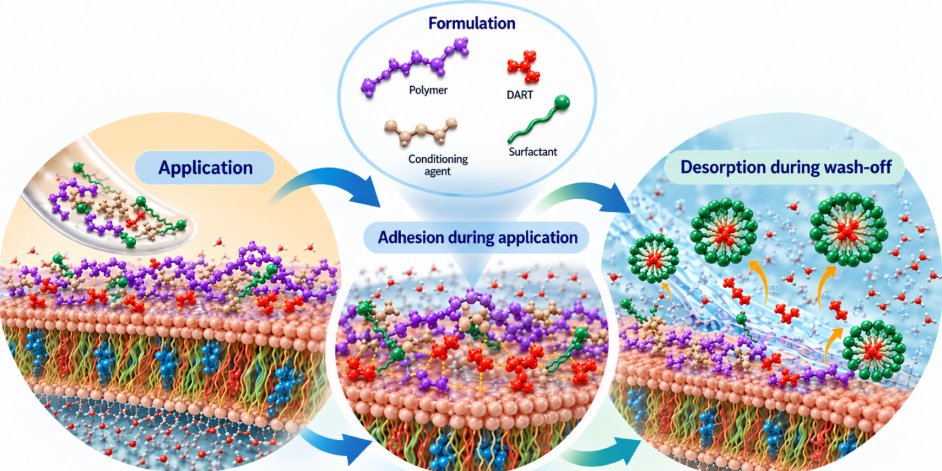
Molecular Interaction and Surface Adhesion
The investigation begins by constructing a representative molecular surface and placing selected formulation ingredients, such as film-forming polymers, conditioning agents, and surfactants, in contact with it. A structured surface lipid model can represent the interfacial region relevant to skin-focused applications. The system is solvated and equilibrated under defined temperature, hydration, and formulation conditions. Trajectory analysis reveals where molecules adsorb, whether they lie flat or form loops, and which segments directly contact the surface. Hydrogen bonding, electrostatic attraction or repulsion, and hydrophobic association help explain why particular configurations are favored. Surface coverage and contact frequency quantify the extent of deposition. Adsorption free-energy profiles provide a thermodynamic measure of ingredient affinity that includes solvent reorganization and molecular flexibility, rather than relying only on pairwise interaction energies. Candidate structures should be compared at matched loading, solvent composition, and simulation settings so observed differences can be attributed to formulation chemistry.
Film Formation and Stability
After adsorption, simulations examine how the ingredients organize into a continuous film or a more discontinuous deposited layer. Film thickness and density profiles show how matter is distributed perpendicular to the surface, while surface coverage indicates whether uncovered regions remain. Polymer-chain orientation, segmental mobility, intermolecular association, and entanglement provide information about film cohesion. A compact, well-connected layer may resist redistribution, whereas a loosely packed deposit may shift or separate more readily. Water uptake, swelling, and local diffusion describe how hydration modifies this organization. Additional controlled shear or deformation simulations can probe whether the film retains its arrangement when the surface is disturbed. Comparing these measures for different ingredient combinations helps identify which polymers or conditioning agents improve deposition, uniformity, and structural stability. Multiple initial configurations and independent runs can be used to check that the trends are reproducible.
Wash-Off and Desorption
To study wash-off, an equilibrated deposited system is transferred to a cleansing environment containing additional water and, where relevant, a chosen surfactant, salt concentration, or pH condition. The analysis follows water penetration into the film, changes in interfacial hydrogen bonding, swelling, and the loss of ingredient–surface contacts. Surfactants can compete for interfacial sites and associate with hydrophobic formulation components, promoting their redistribution into the surrounding solution or surfactant aggregates. Desorption can be monitored through surface-distance distributions, contact lifetimes, surface coverage, and the fraction of ingredients that move away from the interface. Molecular diffusion provides complementary information about how quickly components redistribute. When detachment is infrequent, potential-of-mean-force or other enhanced-sampling calculations can compare the free-energy landscape before and during cleansing. Together these measures help distinguish simple film hydration from genuine ingredient release.
Comparative Formulation Assessment
The final assessment compares each candidate under conditions representing product use and conditions representing washing. A successful formulation should maintain enough adsorption and film cohesion to perform its intended function while showing a clear increase in release propensity during cleansing. The comparison can combine adsorption free energy, contact persistence, coverage, film thickness, hydration, and desorption behavior into a consistent performance profile. Ingredient composition, polymer architecture, charge, hydrophobicity, and surfactant concentration can then be varied systematically to identify the factors controlling this balance. For example, one candidate may provide extensive coverage but retain hydrophobic residues, while another forms an adequate layer that swells and detaches more readily in a surfactant-rich environment. This mechanistic understanding supports rational screening of compositions and the selection of promising formulation strategies. The resulting workflow connects ingredient-level molecular interactions with the practical objectives of adhesion, durability, and effective wash-off, without treating any single molecular property as a complete measure of performance.