
Simulation-Guided Design of Thermally Conductive Battery Interface Composite Materials
Thermally conductive battery interface materials require balanced thermal, electrical, and mechanical properties. Molecular dynamics simulations help researchers understand polymer–filler interactions, interfacial heat transfer, and material behavior. Integrating molecular simulations with multiscale modelling and experimental validation supports systematic material selection, reduces trial-and-error testing, and improves battery thermal management solutions.
Keywords: Battery Thermal Interface Materials; Molecular Dynamics Simulation; Polymer–Filler Interactions; Interfacial Thermal Conductance; Multiscale Modelling.
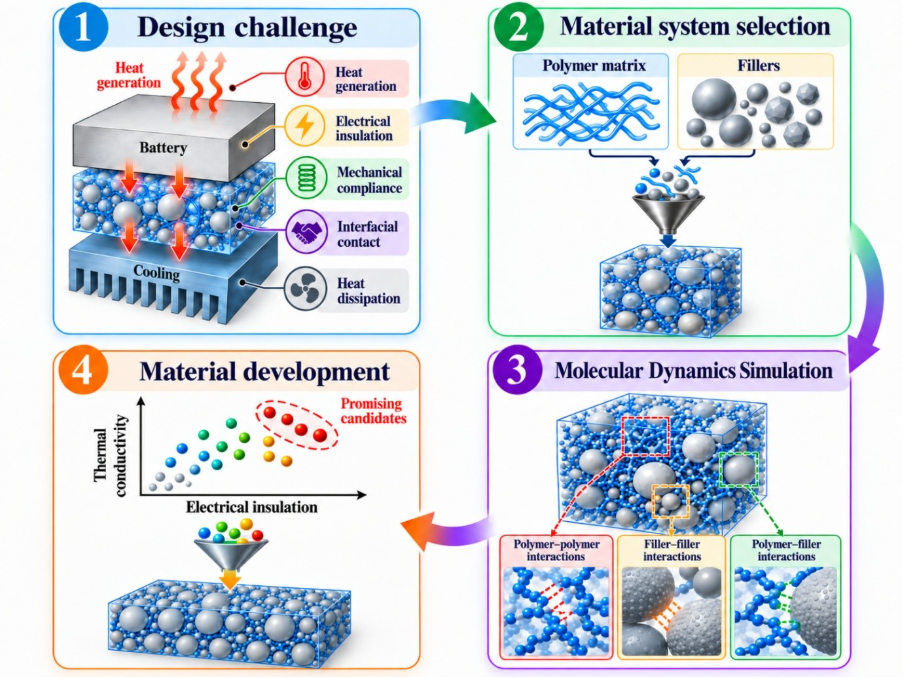
Battery cells generate significant heat during charging and discharging, making effective thermal management essential for battery performance, safety, and reliability. Thermal interface materials help transfer heat from battery cells to cooling systems while maintaining electrical insulation and mechanical flexibility. However, improving one property can affect another. For example, increasing thermally conductive filler content can improve heat transfer but may also increase material stiffness and reduce contact with surrounding surfaces. Balancing these competing properties makes the development of suitable composite materials challenging.
Traditional material development relies on selecting a polymer matrix and fillers, preparing different formulations, and experimentally measuring their properties. Researchers repeatedly modify the material composition until the desired performance is achieved. Although experimental testing remains essential, this approach requires significant time and resources. It also provides limited information about molecular interactions between the polymer matrix and filler surfaces. Understanding these interactions is important because they influence heat transfer, interfacial adhesion, and mechanical behavior.
Molecular simulation provides a systematic approach to understanding these interactions and supports material selection before extensive experimental testing. The workflow begins by defining the required thermal, electrical, mechanical, and interfacial properties. Based on these targets, researchers select suitable polymer matrices and thermally conductive, electrically insulating fillers. Important design parameters include filler composition, particle size, filler content, and surface modification. These parameters influence material compatibility and the overall behavior of the composite.
After selecting the material system, researchers develop atomistic models to investigate its molecular behavior using molecular dynamics (MD) simulations. These simulations describe how atoms and molecules interact and move over time. By studying the polymer–filler interface, researchers examine molecular structure, polymer mobility, interaction energy, and interfacial adhesion. Suitable thermal transport simulations also estimate interfacial thermal conductance, which helps explain how efficiently heat transfers between different material components.
The molecular information obtained from these simulations supports further evaluation of composite materials. Since overall thermal conductivity, stiffness, and electrical performance also depend on larger-scale material structure, atomistic findings can be combined with additional modelling techniques and experimental measurements. This connection helps researchers understand how molecular interactions contribute to the properties observed at the material level.
By connecting molecular-level information with material performance, simulation-guided design provides a scientific basis for comparing different composite formulations. Researchers can identify important design parameters, understand interfacial limitations, and select promising material combinations for experimental testing. This approach reduces dependence on repeated trial-and-error experiments and supports more efficient material development. The knowledge obtained from these studies also provides a foundation for improving material design through additional computational methods.
Building on this foundation, the integration of molecular dynamics, multiscale modelling, machine learning, and experimental validation offers a more comprehensive approach to material development. These methods can work together to explore different material combinations, predict properties, and optimize competing performance requirements. This integrated framework supports the systematic design of thermally conductive battery interface materials and contributes to the development of efficient and reliable thermal management solutions for advanced battery technologies.