
Simulation-Guided Design of High-Performance Polymers
Simulation-Guided Design of High-Performance Polymers
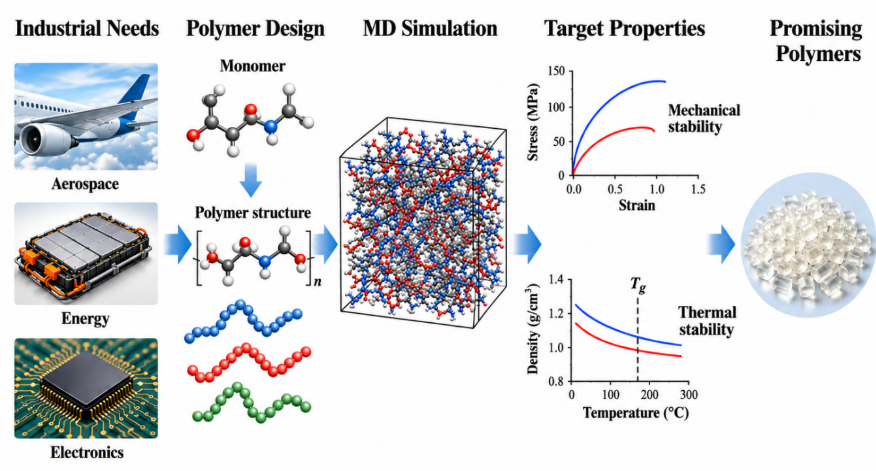
Aerospace components, electric vehicle battery insulation, and electronic packaging require polymers that balance strength, toughness, flexibility, and thermal stability. Molecular dynamics simulations connect polymer structures with mechanical, thermal, and processing properties. This computational approach supports material selection, reduces experimental trial-and-error, and guides application-specific polymer development.
Keywords: High-Performance Polymers, Molecular Dynamics, Structure–Property Relationships, Mechanical Properties, Thermal Stability
High-performance polymers play an important role in the automotive, aerospace, electronics, energy, healthcare, and packaging industries. Each industry requires materials with specific mechanical, thermal, and processing properties. Automotive and aerospace applications require lightweight polymers with high strength, toughness, and thermal stability. Electronics and energy systems need materials that maintain their performance under different operating temperatures. Healthcare and packaging applications require flexibility, durability, and reliable processing. These diverse industrial requirements create a growing demand for polymers that combine multiple properties within a single material.
However, developing polymers with these combined properties remains challenging through traditional experimental methods. Conventional polymer development involves material synthesis, characterization, and repeated testing to achieve the desired performance. Improving one property often affects another. For example, increasing polymer chain rigidity improves stiffness but may reduce flexibility and toughness. Similarly, increasing crosslink density can improve dimensional stability while limiting molecular movement and processability. Exploring different monomers, molecular weights, copolymer compositions, and processing conditions requires considerable time, materials, and experimental effort. These limitations make it difficult to identify suitable polymer structures efficiently.
To address these challenges, computational molecular simulations provide a systematic approach to polymer design and property evaluation. Molecular dynamics (MD) simulations help researchers understand how polymer chains interact, move, and respond to mechanical deformation and temperature changes. These simulations connect molecular structure with material behavior and provide information that is difficult to obtain through experiments alone. By studying different polymer structures computationally, researchers can compare their properties and select promising candidates before experimental synthesis.
The computational methodology begins by defining application-specific requirements, including strength, toughness, flexibility, thermal stability, and processability. Relevant experimental data and molecular structures are collected from scientific literature and polymer databases. Based on these requirements, different polymer candidates are generated by modifying monomer structures, backbone chemistry, copolymer composition, molecular weight, chain architecture, and crosslink density. Each selected polymer structure is converted into a three-dimensional molecular model and equilibrated using suitable molecular force fields. MD simulations then evaluate mechanical behavior through controlled deformation and stress–strain analysis. Temperature-dependent simulations estimate glass transition behavior and thermal expansion, while suitable reactive simulations investigate possible thermal degradation pathways. Further analysis of polymer chain mobility, entanglement, stress relaxation, and viscosity provides information about viscoelastic behavior and processability.
The results from these simulations establish relationships between polymer molecular structure and material performance. Comparing different polymer candidates helps identify how molecular changes influence mechanical strength, flexibility, thermal behavior, and processing characteristics. Promising structures are further evaluated against the original design requirements and available experimental measurements. This systematic approach supports material selection, reduces unnecessary experimental trials, and provides a scientific basis for polymer development.
Simulation-guided polymer design also creates opportunities for more efficient material discovery. The integration of molecular simulations, experimental data, and automated computational workflows supports the evaluation of broader polymer design spaces. Further improvements in multiscale modelling and experimental validation strengthen the connection between molecular behavior and practical material performance. This approach provides a foundation for developing application-specific, high-performance polymers across different industries.