Affinity Meets Selectivity: Designing Next-Generation Mineral Collectors
Industrial mining operations separating scheelite (CaWO4) from calcite (CaCO3) replaced energy-intensive fatty acid steam-heating circuits with first-principles-designed aromatic hydroxamic acid collectors, cutting pulp heating energy consumption to ambient temperatures (15°C–25°C) while boosting WO3 recovery from 74.5% to 84.1% and widening the single-mineral selectivity margin to 71.5%.
|
Metric |
Before (Fatty Acid / Petrov Process) |
After (Aromatic Hydroxamic Acid System) |
|
Pulp Conditioning Temperature |
80°C – 90°C (Steam Heating) |
15°C – 25°C (Ambient Temperature) |
|
Sodium Silicate Depressant Dosage |
2000 – 3000 g/t |
150 – 300 g/t |
|
WO3 Flotation Recovery |
74.5% – 78.2% |
82.3% – 84.1% (+6.3% Increase) |
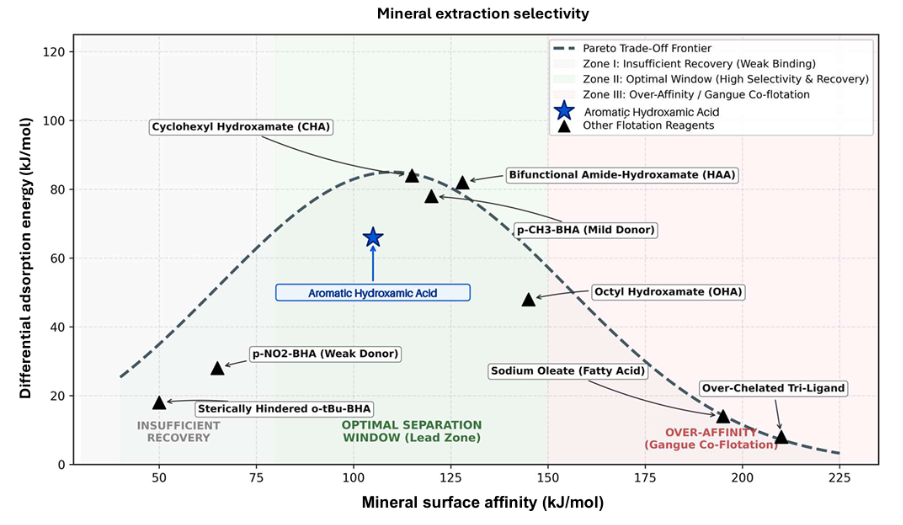
Scheelite (CaWO4) and calcite (CaCO3) share identical surface Ca2+ cations. Traditional fatty acids (e.g., sodium oleate) possess high non-specific electrostatic affinity (ΔEads > 190 kJ/mol), causing indiscriminate chemisorption on both minerals and complete selectivity collapse (ΔR < 3.5%).
Industrial concentrators were forced to rely on the Petrov method, burning heavy fossil fuels in steam boilers to inject 90°C steam alongside massive sodium silicate dosages (3000 g/t) to thermally desorb oleate from calcite, creating severe pipe scaling, excessive carbon emissions, and heavy tungsten losses in tailings.
Multi-scale density functional theory resolved the gas-phase paradox, proving that selective flotation is governed not by vacuum binding affinity, but by interfacial water desolvation barriers.
Quantum mechanical modelling identified that Calcite (104) binds water exothermically (ΔEads = -36.51 kJ/mol), creating a +61.66 kJ/mol desolvation barrier that rejects moderate-affinity collectors, while Scheelite (112) binds water loosely (+25.14 kJ/mol), enabling spontaneous displacement by pre-organized (Z)-hydroxamates.
-
First-principles molecular DFT screens show that the ligand binds (2.59 Å) to enforce five-membered mononuclear [Ca–O–C–N–O] bidentate chelation while excluding binuclear bridging across wide Ca–Ca lattices (> 3.9 Å).
-
Periodic slab micro-hydration quantifies water desolvation penalties, mapping the +61.66 kJ/mol interfacial activation barrier.
-
Competitive adsorption Pareto optimization identifies collectors operating within the optimal affinity window (80–140 kJ/mol), achieving a net +23.82 kJ/mol (+0.2468 eV) competitive advantage for scheelite over calcite.
-
Reagent lead candidates are screened computationally in hours before pilot flotation trials, cutting wet-lab synthesis iterations by 90%.
|
Outcome |
Detail |
|
Single-Mineral Selectivity Gap |
Calcite recovery suppressed to <18% while scheelite reaches 88% (ΔR ≈ 71%) |
|
Concentrate Grade & Purity |
Industrial WO3 concentrate grade improved to 66.2% – 68.5% at ambient temperature |
|
Thermal Energy Elimination |
100% elimination of steam heating boilers and coal consumption in flotation circuits |
While this study demonstrates the potential of molecular simulations for selective scheelite–calcite separation, it represents an initial step toward a broader computational discovery strategy. This approach can be extended to diverse mineral systems, complex ore compositions, and a wide range of collector chemistries, enabling the design of tailored flotation reagents for specific industrial challenges.
By integrating molecular simulations, machine learning, and experimental validation, this strategy can evolve into a scalable platform for accelerated reagent discovery. For mining industries, it offers opportunities to reduce trial-and-error experimentation, enhance mineral recovery and purity, lower operational costs, and minimize environmental impact, ultimately enabling smarter, more efficient, and sustainable mineral processing.