
Low-dose Cleaning Formulation
Why the best cleaning formulation is not always the one with the most surfactant?
Can a detergent clean just as well with less surfactant? A survey of peer-reviewed studies, from molecular simulations of oil lifting off silica to washing tests on fabric, points to the same answer: cleaning depends on getting the right molecules to the right place at the right time, not on adding more. Too little surfactant leaves oil pinned to the surface; too much can crowd the surface, hold on too tightly, or slow the supply of fresh surfactant to where it is needed.
The cleaning sweet spot: not too little, not too much
To lift oil off a surface, water has to get between the oil and the solid. Surfactants help in two ways: they lower the tension between oil and water, and they disturb the oil film so that water can wedge underneath. Without enough surfactant, the oil stays put. But several studies show that more surfactant is not automatically better. Surfactant that binds too strongly to the surface, or that is locked away in very stable micelles, can slow cleaning down.
Every gram of surfactant saved lowers cost and the chemical load that goes down the drain, and formulations that work in cold water save the energy used to heat it. The research question is "how do we get the most cleaning from every molecule?"
What happens at the molecular scale?
Liu and co-workers (2012) used molecular dynamics to watch an alkane film leave a silica surface in a solution of the cationic surfactant CTAB. The first oil layer packs in an ordered way and turns the hydrophilic silica hydrophobic. Once surfactant is added, the oil is removed in three stages:
-
Breakthrough: a water channel forms through the oil film between the surfactant solution and the silica. The authors identify this channel as vital for detachment.
-
Spreading: water forms a gel-like layer on the silica near the oil–water–solid contact line, held there by hydrogen bonds and electrostatic attraction.
-
Release: the surface becomes hydrophilic again and the oil ends up solubilized in surfactant micelles.
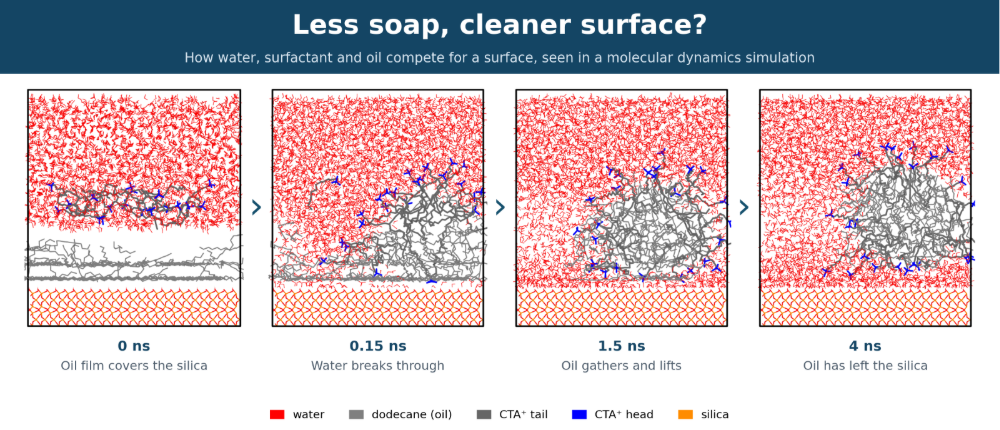
Later simulations added detail. Tang et al. (2018) found that surfactant molecules disturb the oil layer and so help water slip underneath, that a water channel forms only when the silica surface is polar enough, and that ionic surfactants (DTAB, SDBS) widen the channel faster than the nonionic OP-10. In flowing nanochannels, Tang et al. (2019) saw surfactant gather at the rear of an oil droplet ("flooding from rear"), with the sulfonate surfactant SDBS displacing oil more efficiently than DTAB because its head group binds water more strongly. Yan and Yuan (2016) found the same water channels forming around surfactant head groups inside silica nanopores. The banner above shows this sequence in our own simulations.
When more surfactant backfires
Four studies, using very different methods, describe how extra or over-strong surfactant can slow parts of the cleaning process:
-
Crowding. In coarse-grained simulations, dilute nonionic surfactant solutions removed dodecane and eicosane from silica better than concentrated ones, and the charged surfactant hindered removal (Pérez-Sánchez et al., 2023). The authors conclude that phase behaviour, not only surfactant type, controls detachment.
-
Friction at the contact line. In experiments, cationic surfactant adsorbing on silica slowed the oil/water/silica contact line by three orders of magnitude above a threshold concentration just below the CMC; strongly bound surfactant trapped under the oil raises the line friction (Rondepierre et al., 2021).
-
Holding on too tightly. Nonionic surfactants with longer propylene-oxide segments adsorbed more strongly on a model dirt surface but desorbed more slowly under flow, and cleaned worse in washing tests (Osato et al., 2025).
-
Too-stable micelles. Sodium dodecyl sulfate micelles were most stable at 200 mM. That solution wetted fabric most slowly, because stable micelles release surfactant to new interfaces slowly, although it also solubilized oil fastest. Micelle stability is a design handle that helps some washing steps and hinders others (Patist et al., 1999).
Testing the idea: our CTAB concentration series
We tested the same question in our own simulations. A film of 93 dodecane molecules on an α-quartz silica slab carrying 12 charged SiO⁻ sites was covered with 3,897 water molecules and 6, 9, 12, 18, 27 or 54 CTA⁺ ions (Na⁺ or Br⁻ keep each box neutral). Each system was run for 10 ns at 298 K in GROMACS. We timed when water reached the silica, when the wet patch spanned the box, when half of the oil contact was gone and when the surface was completely clean.
-
Water always gets in fast. In every run, ten or more water molecules reached the silica within 17–42 ps.
-
A middle loading cleaned fastest. With 27 CTA⁺, half of the oil was off at 0.39 ns and the surface was clean at 2.97 ns; at the other loadings this took 0.55–1.11 ns and 3.61–6.26 ns.
-
The highest loading was slowest to start. With 54 CTA⁺, the wet patch took 1.45 ns to span the box (0.15–0.38 ns in the other runs) and half of the oil came off only at 1.11 ns. Early on, CTA⁺ heads sat on 5 of the 12 SiO⁻ sites and the water touching those sites halved: the crowding effect described above.
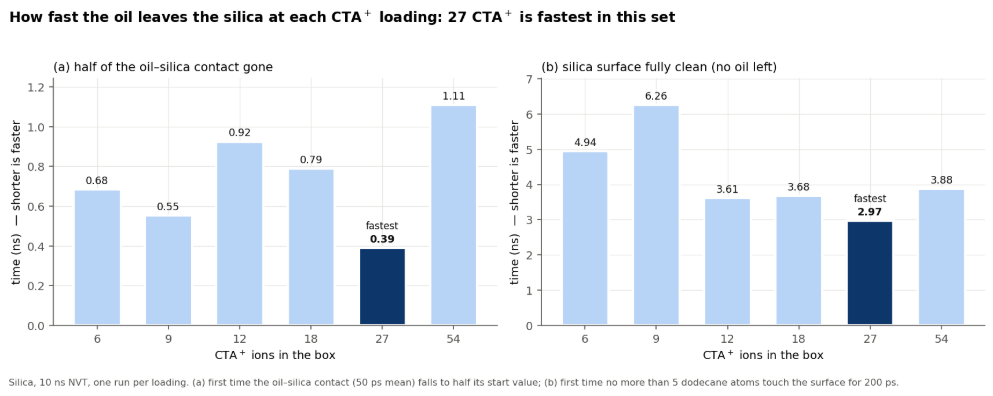
Time to remove half of the oil (a) and to clean the surface completely (b) at each CTA⁺ loading. Shorter bars are faster; one 10 ns simulation per loading.
Getting more cleaning from every gram
The several routes that reach good cleaning performance at low surfactant levels:
|
Strategy |
How it helps |
Reported result |
Source |
|
Synergistic mixtures |
Two surfactants pack more effectively at the oil–water interface than either alone; theory can predict good pairs from their structures |
Ultralow interfacial tension (10⁻³ mN/m range) below 0.05 wt%, even below 0.01 wt%, with the right mixture ratio |
Rosen et al. 2005; Shiloach & Blankschtein 1998; Grady 2023 |
|
Extended surfactants |
An intermediate-polarity linker sits between the oily tail and the charged head |
Ultralow interfacial tension with hexadecane, triolein and vegetable oils at ppm levels |
Witthayapanyanon et al. 2006 |
|
Microemulsion-based washing |
Formulate close to the middle-phase (Winsor III) region |
Better oily-soil removal than a commercial liquid detergent; performance at 25 °C close to 55 °C |
Tongcumpou et al. 2003 |
|
Gemini surfactants |
Two surfactant units joined by a spacer |
Much lower CMC and stronger surface activity than comparable conventional surfactants |
Rosen & Tracy 1998 |
|
Biosurfactant additives |
Lipopeptide from Bacillus subtilis SPB1 added to a detergent |
Oil-stain removal 33% → 45% when added to a commercial detergent |
Bouassida et al. 2018 |
|
Smarter rinsing |
The surfactant concentration gradient during a fresh-water rinse pulls dirt out of small pores |
Removes soil from fabric pores that flow alone cannot reach |
Shin, Warren & Stone 2018 |
Reading the table: most routes do not add surfactant. They make each molecule work harder, by packing it better at the interface, giving it a better shape, or changing the wash and rinse so that it reaches the soil.
The takeaway
The best cleaning formulation is not the one with the most surfactant—it is the one that gets water to the surface and lets the oil go.
Molecular simulations show that cleaning starts when water breaks through the oil film to the surface. Experiments and coarse-grained models show that surfactant which crowds the surface, binds too tightly or is released too slowly can work against that step. Our own CTAB series points the same way: a middle loading cleaned fastest, while the highest loading crowded the surface and opened the water channel slowest. Better chemistry (synergistic mixtures, extended and gemini surfactants, biosurfactants) and better process (formulating for low temperature, using the rinse) deliver more cleaning from less surfactant.
As detergents move to lower doses and colder washes, knowing why a formulation works becomes as valuable as knowing that it works. Combining molecular simulation with targeted washing tests lets formulators screen ideas before they reach the lab, and makes each experiment count.
References
-
-
Liu Q., Yuan S., Yan H., Zhao X. (2012). Mechanism of oil detachment from a silica surface in aqueous surfactant solutions: molecular dynamics simulations. J. Phys. Chem. B 116, 2867–2875. doi:10.1021/jp2118482
-
Tang J. et al. (2018). Molecular dynamics simulations of the oil-detachment from the hydroxylated silica surface. J. Phys. Chem. B 122, 1905–1918. doi:10.1021/acs.jpcb.7b09716
-
Tang X. et al. (2019). Molecular dynamics simulation of surfactant flooding driven oil-detachment in nano-silica channels. J. Phys. Chem. B 123, 277–288. doi:10.1021/acs.jpcb.8b09777
-
Yan H., Yuan S. (2016). Molecular dynamics simulation of the oil detachment process within silica nanopores. J. Phys. Chem. C 120, 2667–2674. doi:10.1021/acs.jpcc.5b09841
-
Pérez-Sánchez G. et al. (2023). Coarse-grain molecular dynamics simulation framework to unravel the interactions of surfactants on silica surfaces for oil recovery. Colloids Surf. A 670, 131583. doi:10.1016/j.colsurfa.2023.131583
-
Rondepierre G. et al. (2021). Dramatic slowing down of oil/water/silica contact line dynamics driven by cationic surfactant adsorption on the solid. Langmuir 37, 1662–1673. doi:10.1021/acs.langmuir.0c02746
-
Osato N. et al. (2025). Effect of propylene-oxide segment length on cleansing performance of detergents with nonionic surfactants. J. Surfactants Deterg. 28, 1369–1379. doi:10.1002/jsde.12895
-
Patist A., Jha B.K., Oh S.-G., Shah D.O. (1999). Importance of micellar relaxation time on detergent properties. J. Surfactants Deterg. 2, 317–324. doi:10.1007/s11743-999-0083-6
-
Rosen M.J., Wang H., Shen P., Zhu Y. (2005). Ultralow interfacial tension for enhanced oil recovery at very low surfactant concentrations. Langmuir 21, 3749–3756. doi:10.1021/la0400959
-
Shiloach A., Blankschtein D. (1998). Predicting micellar solution properties of binary surfactant mixtures. Langmuir 14, 1618–1636. doi:10.1021/la971151r
-
Grady B.P. (2023). Surfactant mixtures: a short review. J. Surfactants Deterg. 26, 237–250. doi:10.1002/jsde.12642
-
Witthayapanyanon A., Acosta E., Harwell J.H., Sabatini D.A. (2006). Formulation of ultralow interfacial tension systems using extended surfactants. J. Surfactants Deterg. 9, 331–339. doi:10.1007/s11743-006-5011-2
-
Tongcumpou C. et al. (2003). Microemulsion formation and detergency with oily soils: II. Detergency formulation and performance. J. Surfactants Deterg. 6, 205–214. doi:10.1007/s11743-003-0263-4
-
Rosen M.J., Tracy D.J. (1998). Gemini surfactants. J. Surfactants Deterg. 1, 547–554. doi:10.1007/s11743-998-0057-8
-
Bouassida M. et al. (2018). Potential application of Bacillus subtilis SPB1 biosurfactants in laundry detergent formulations. Eng. Life Sci. 18, 70–77. doi:10.1002/elsc.201700152
-
Shin S., Warren P.B., Stone H.A. (2018). Cleaning by surfactant gradients: particulate removal from porous materials and the significance of rinsing in laundry detergency. Phys. Rev. Applied 9, 034012. doi:10.1103/PhysRevApplied.9.034012
-
Taddese T., Anderson R.L., Bray D.J., Warren P.B. (2020). Recent advances in particle-based simulation of surfactants. Curr. Opin. Colloid Interface Sci. 48, 137–148. doi:10.1016/j.cocis.2020.04.001
-
Jiménez-Serratos G. et al. (2025). Modeling contact angles with chemically specific dissipative particle dynamics. Langmuir 41, 3877–3887. doi:10.1021/acs.langmuir.4c04023
-